
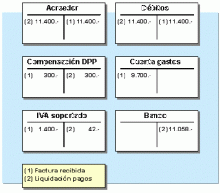
In the Accounts Payable area, the traditional distinction between invoice with Purchase Order and without Purchase Order is evident in the processing (different types of tasks) and in the accounting entries in the invoice register.
Types of invoices
Accounting depending on invoice types
Invoice types: Invoices without purchase order
In invoices without orders, the accounting record of invoices is usually a debit in expense accounts and analytical accounting items, if any. It is therefore necessary to be familiar with the company's accounting plan and to use it correctly and consistently in order to make the entry.
These circumstances must be taken into account when choosing the people responsible (based on their training and experience) for performing the task, as well as when training them in the use of accounts, cost centers, and other elements used in the company's accounting. Ensuring that the different people who record expenses follow the same criteria and work in a consistent manner will guarantee that the information provided by the financial statements is analyzable and can be used as a source for decision-making.
Invoice types: Invoices with purchase order
However, in invoices with orders, it is normal for the invoice record to "kill" a provision for invoices pending receipt. The expense is recorded at another point in time, which usually occurs when the receipt of the goods or services is recorded. Furthermore, accounting allocations to expense accounts are not made in the traditional way by selecting an account, but are usually attributes of the order elements: materials, warehouses, etc.
These elements mean that the purely accounting function is shifted to the moment of creation of the material, supplier, and warehouse masters, leaving the invoice entry more as a task of conforming and identifying differences than as an accounting task. Therefore, in order for the accounting information created to be correct, it will be necessary for the people who create the master records for materials, warehouses, orders, etc. to have sufficient training to understand the implications for the company's accounting of using one type of record or another.
And, as a bridge account, the account for the provision of invoices pending receipt must be periodically reviewed, as it will serve as an element to identify expenses pending formalization and balances that may have been incorrectly recorded.