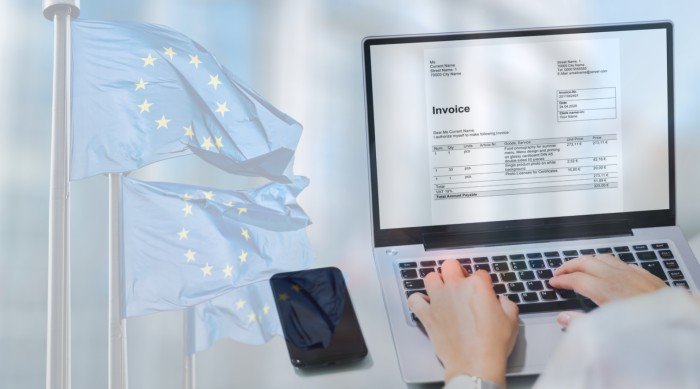
The electronic invoicing in Europe is not only a reality, but also a requirement. In fact, being part of the EU means that many laws are common to all member states. Online invoicing is no exception. Likewise, all European public administrations are currently required to use it. However, despite the existence of a common legislative framework, each country has its own national regulations in this regard. At easyap, we review the current status of electronic invoicing in Europe and what differences exist between the various countries.
Which countries currently use electronic invoicing in Europe?
All of them. Since the regulation came into effect in April 2020, all public administrations in Europe are required to use electronic invoicing. This is regulated by Directive 2014/55/EU and has three main objectives:
- Continue with the digital transformation of the entire continental business fabric and take advantage of the many benefits offered by the online world.
- To contribute to better traceability of corporate taxation in different eurozone countries and thus combat tax evasion, which remains a problem for many nations today.
- Reducing trade barriers between EU countries.
Until very recently, different regulations and requirements existed between countries, meaning that the difficulties and obstacles arising in cross-border transactions without digital invoicing were much greater than they are today. However, with this regulation, certain barriers have been removed.
Furthermore, in accordance with the governments of the European Union countries implement electronic invoicing in public processes, more and more private companies are using and standardizing it. Likewise, B2B electronic invoicing is gaining more and more followers in Europe. What's more, B2B online invoicing has its own regulations, as it complies with Directive 2010/45/EU. This directive also stipulates important issues such as EDI systems and the validity of digital signatures.
Status and latest developments regarding electronic invoicing
Apart from EU regulations, each country has its own internal regulations. From easyap , we are aware of this because we have carried out projects both in Europe and in many other countries. So, below, we will discuss the legal situation regarding electronic invoicing in Europe based on both current regulations and our own experience.
Germany
Despite being one of the continent's powerhouses and one of the most advanced nations on the planet, it currently only requires electronic invoicing in the public sector. It should be remembered that it is a federal republic, so each state decides its policies independently.
Belgium
In Belgium, B2G electronic invoicing (for governments) has been mandatory for almost ten years. Specifically, since 2013, it has been mandatory for both the government and its suppliers. As for B2B electronic invoicing, the intention is to make it mandatory by 2023, based on regulations in other European countries.
Cyprus
Since the beginning of 2022, B2G electronic invoicing has been mandatory on this Mediterranean island. Therefore, any transaction carried out by a company with the Public Administration will require an electronic invoice. However, this is still a very recent policy measure.
Denmark
In Denmark, an innovative country at the forefront of technological advances, electronic invoicing is currently only mandatory for public administrations and their suppliers. But it has been so for a long time, specifically since 2005.
Spain
The electronic invoicing is mandatory for the Public Administration and in transactions between its subcontractors and contractors when the value of these exceeds €5,000. In the B2B sphere, the the Create and Grow Law, which is so important for implementing digital invoicing between companies and businesses of all kinds, is already being processed.
Finland
The e-invoice is very widespread in Finland. Since 2010, all public administrations have preferred to receive digital invoices, although it has not been mandatory until 2020 due to European regulations. In the private sector, the situation is similar, since, despite not being required by law, it is used in many companies.
France
In France, electronic invoicing has been in use since 1990. However, since 2020, it has been mandatory for the public administration in its dealings with suppliers. Furthermore, it appears that between 2024 and 2026, it will also be applied to other companies, revolutionizing the private sector.
Italy
Italy has an electronic invoicing system (SDI) that has served as a reference for many countries in Europe. To be more specific, since 2014, electronic invoicing for public administrations (known as FatturaPA) has been mandatory, and in 2019 it was also established as such for private companies.
Luxembourg
A country with a particular tax and fiscal system is Luxembourg. In terms of electronic invoicing, it has a national regulation from 2021 that requires all companies to issue electronic invoices to government institutions through PEPPOL. It is being implemented progressively, starting with large companies and ending with SMEs in 2023.
Norway
In the Scandinavian country, all companies must file their tax returns through a new system based on accounting information. To do this, SAF-T tax codes will be used SAF-T codes will be used for this purpose. In turn, this system allows the return to be filed by the company itself from its own ERP.
Portugal
Our Portuguese neighbors are updating at a good pace. Starting this year , a QR code containing all the company's information is mandatory on any electronic invoice , and, as of this summer, they must be validated with a digital signature. In addition, starting in 2023, all e-invoices and tax documents must include the ATCUD code (Code Validation Sequential Number).
Poland
We list Poland because it has one of the most unique electronic invoicing systems in Europe. Since 2021, e-invoicing has been voluntary, and from 2023 it will be mandatory, both between private companies and with the relevant administration. In turn, it is the Administration that validates each transaction, and to this end, the government has set up the National Electronic Invoicing System (KSeF).
Romania
To cite the situation of one of the least developed countries in Europe, we can look at the case of Romania. Specifically, since 2021, electronic invoicing has been mandatory for public administrations and Romanian companies. Furthermore, from 2022 onwards, all companies will be required to issue their electronic invoices through the SAF-T system.
E-invoicing in Europe vs. the rest of the world
And compared to the rest of the world, what is the outlook for electronic invoicing? To answer this question, we will discuss the situation in some of the most powerful countries on the planet. Or, at least, the most emerging ones.
Australia (and New Zealand)
Australia launched its electronic invoicing initiative in 2018, together with New Zealand. Following this digitization strategy, in recent years it has promoted its use among private and public companies. However, as of this year, there is a mandatory plan requiring government agencies to implement electronic invoicing.
Brazil
Brazil is the most powerful issuer of electronic invoices in Latin America. It is also world leader in the issuance of electronic tax documents through its various electronic invoice models. Likewise, the Brazilian system is one of the most consolidated systems on the planet and is a country where electronic invoicing is 100% mandatory, as is electronic signatures.
China
For the Asian giant, this is a time of change. For now, electronic invoicing is only mandatory for new taxpayers and only in the case of B2C (direct customer sales) and B2B. For all other companies, it is voluntary.
United States
It is a highly digitized country, but one that does not have a unified legal framework for electronic invoicing. There is no single, nationwide law, so many state agencies are trying to offer legal solutions in this area. In turn, multiple different invoicing platforms and systems for both B2G and B2B.
India
Still a developing country, India stands out as a technological powerhouse, while also emerging in many other fields. In 2019, it implemented a plan to gradually introduce electronic invoicing. It is currently in the process of mandatory mass adoption. The aim is to combat significant accounting problems in the country, such as complex tax returns for companies and high levels of tax evasion, and to improve communication between organizations.
In conclusion, we can only offer you one recommendation: digital transformation and electronic invoicing are a reality, as well as a necessity. Not only in Spain, but across the globe. In fact, within a few years, it will be mandatory in all areas, not just B2G. Our experience implementing accounting and technology solutions in various companies around the world can help you take the step you need to take. Shall we talk?